For sellers6 min read
A Practical Shot List for a Clearer Horse-Sale Listing
A useful photo set helps a buyer understand which horse is for sale and what the seller is describing. It does not need to look like a magazine shoot. It does need to be current, clear, and honest.
Plan the session before bringing out the horse, then adapt this shot list to the day.
Prepare before the horse comes out
Charge the phone or camera, clean the lens, check storage, and list the views you need. Create a separate folder for each horse.
Choose usable light. Check the background for clutter, loose equipment, vehicles, other animals, and anything that could distract the horse or block the view.
Basic grooming can help the horse's markings and outline show clearly. The goal is an accurate record of the horse on that date, not a cosmetic transformation.
Put handling and setting first
Use a capable handler who knows the horse. Penn State Extension's horse-handling guidance notes that horses respond to their surroundings and recommends help from an experienced equine professional when problems come up. Choose firm, even footing and a familiar area when possible. Account for gates, traffic, equipment, loose dogs, and bystanders. Follow the handler's direction.
No requested view is worth forcing. If the horse becomes worried, the footing changes, or the setting stops being suitable, pause or end the session. The Retired Racehorse Project's photo guide gives the same advice: take breaks, and if it is not working, call it a day and try again another time.
Establish when the photos were taken
Keep the session date in your own records and include it in seller-provided text where the current listing supports that context. Keep the original files when possible in case an edited copy or repost loses its date information.
If images come from more than one day, label them separately. Do not describe an older photo as current. A dated caption such as "Photographed October 2026" is clearer than "recent photo."
Take the whole-horse views
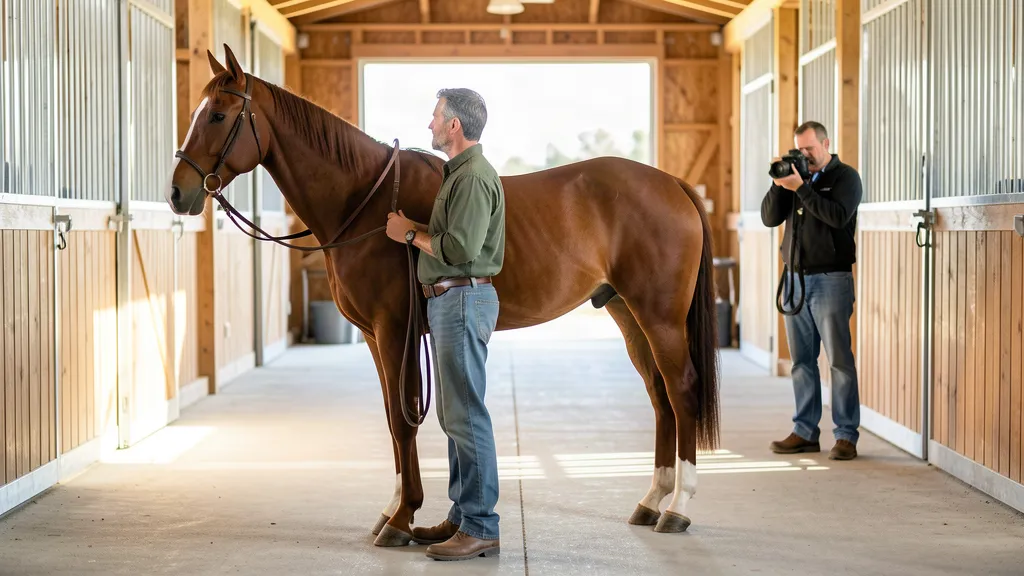
When practical, take clear whole-horse views from the left side, right side, front, and rear. The Retired Racehorse Project's selling advice suggests exactly these views, with the horse standing fairly square on level ground and no shadows over the legs. These are documentary views, not an invitation to make a conformation, soundness, or suitability judgment from a screen.
Frame the entire horse, including ears, feet, and tail. Keep the camera level with the horse's body. The Retired Racehorse Project's conformation-photo guide notes that shooting from an angle can distort the horse's proportions. Take several frames of each view.
Conditions will not always allow every angle. Publish the useful views you obtained without forcing the horse and explain if a requested image is unavailable.
Record identifying details
Add closer images of visible identifying markings, such as facial and leg markings. The Retired Racehorse Project's photo guide suggests head shots that show a horse's markings. Pair them with the whole-horse set for context.
Check that each detail is clear, in focus, and not hidden by tack.
Photograph feet and legs as documentary views
If the listing calls for them and the horse handles calmly for it, take clear views of the feet and lower legs, photographing the front and hind legs separately as the Retired Racehorse Project suggests. Treat these as a record of what was visible at the session. Do not label an image as proof of hoof balance, limb correctness, soundness, health, or future performance.
Avoid captions that interpret what the picture means. A plain label such as "left front foot, photographed November 2026" gives the buyer context without turning the seller's photo into an assessment.
Match work and context photos to the description
Include images that relate directly to the horse's current description. If the listing says the horse is in regular ridden work, driving, showing in hand, or doing another activity, current photos of that activity can add context. State when the image was taken and, when relevant and permitted, who is riding, driving, or handling.
Do not stage unfamiliar work only to create a sale image. Do not use an old competition photo as evidence of what the horse is doing now without giving its actual date. Past images can still be useful when they are labeled as past history.
Edit for clarity, not a different reality
The Retired Racehorse Project's selling advice is short: always be honest. Cropping, straightening, and modest exposure or color correction can make a photo easier to read. Edits should not change the horse, remove identifying features, disguise the setting, or create a false impression of condition, color, movement, scale, or activity.
Skip heavy filters, reshaping tools, background replacement, and object removal that hides relevant context. If a distracting but harmless object needs to be cropped out, make sure the crop does not cut off part of the horse. Keep the unedited originals.
Select the final set
Choose one strong lead image, then remove near-duplicates, blurry frames, screenshots, and images in which another horse could be mistaken for the listed horse. Check captions, dates, and file order.
Do not let a polished lead photo replace the practical views that identify the horse and document the seller's description.
Get permission and protect privacy
Use only images you have the right and any required permission to publish. Avoid recognizable children, private documents, addresses, vehicle plates, and other unnecessary personal information. When rights or permission are uncertain, use another image or obtain appropriate guidance.
Review backgrounds at full size. Crop or blur private information when that edit does not misrepresent the horse or the activity.
Remember what photos cannot establish
Photos capture selected moments. They cannot establish health, soundness, training, temperament, value, suitability, or future performance by themselves. Penn State Extension describes even a veterinary prepurchase exam as "a snapshot in time" and "not a pass or fail test." Photos cannot replace direct questions, current records, an in-person visit, or independent professional advice.
On Barn2Buyer, the photos and details in a listing are supplied by the seller. Barn2Buyer does not inspect horses, verify photos or when they were taken, decide suitability, or give veterinary advice. It is not part of the sale and does not broker it. Buyers and sellers deal with each other directly, and the buyer chooses whether to get an independent veterinary exam and other professional advice.
The seller's job is simpler: show the current horse clearly, label the context honestly, and leave conclusions to the buyer and the qualified people the buyer consults.
Build your listing on Barn2Buyer
Ready to organize your horse's current photos and details? List your first horse free on Barn2Buyer in five short steps, with no card needed. Your first horse listing stays free until it is sold, as long as you confirm it is still for sale when we ask, about every 90 days. There is one free horse listing per account.
Create free accountSources
- Retired Racehorse Project, Erica Larson, "Tips For Selling Your OTTB" (originally in Off-Track Thoroughbred Magazine, Summer 2016; side, front and rear views, level ground, no shadows on the legs, honesty): https://therrp.org/education/buying-selling/tips-for-selling-your-ottb (read 2026-11-16)
- Retired Racehorse Project, Erin Harty, "How to Take a Jaw-Dropping Conformation Photo" (camera angle and proportions, head shots for markings, separate front and hind leg close-ups, breaks and stopping): https://therrp.org/education/buying-selling/how-to-take-a-jaw-dropping-conformation-photo (read 2026-11-16)
- Penn State Extension, Bethany Bickel, "Safe Horse Handling" (horses respond to their surroundings, help from an experienced equine professional): https://extension.psu.edu/safe-horse-handling (read 2026-11-16)
- Penn State Extension, Bethany Bickel, "Pre-Purchase Exams" (the exam as a snapshot in time, not a pass or fail test): https://extension.psu.edu/pre-purchase-exams (read 2026-11-16)